Two papers on how markets, and the people in them, behave.
One tests machine-learning models on 14 global stock indices. The other asks whether calm, self-controlled investors manage money better.
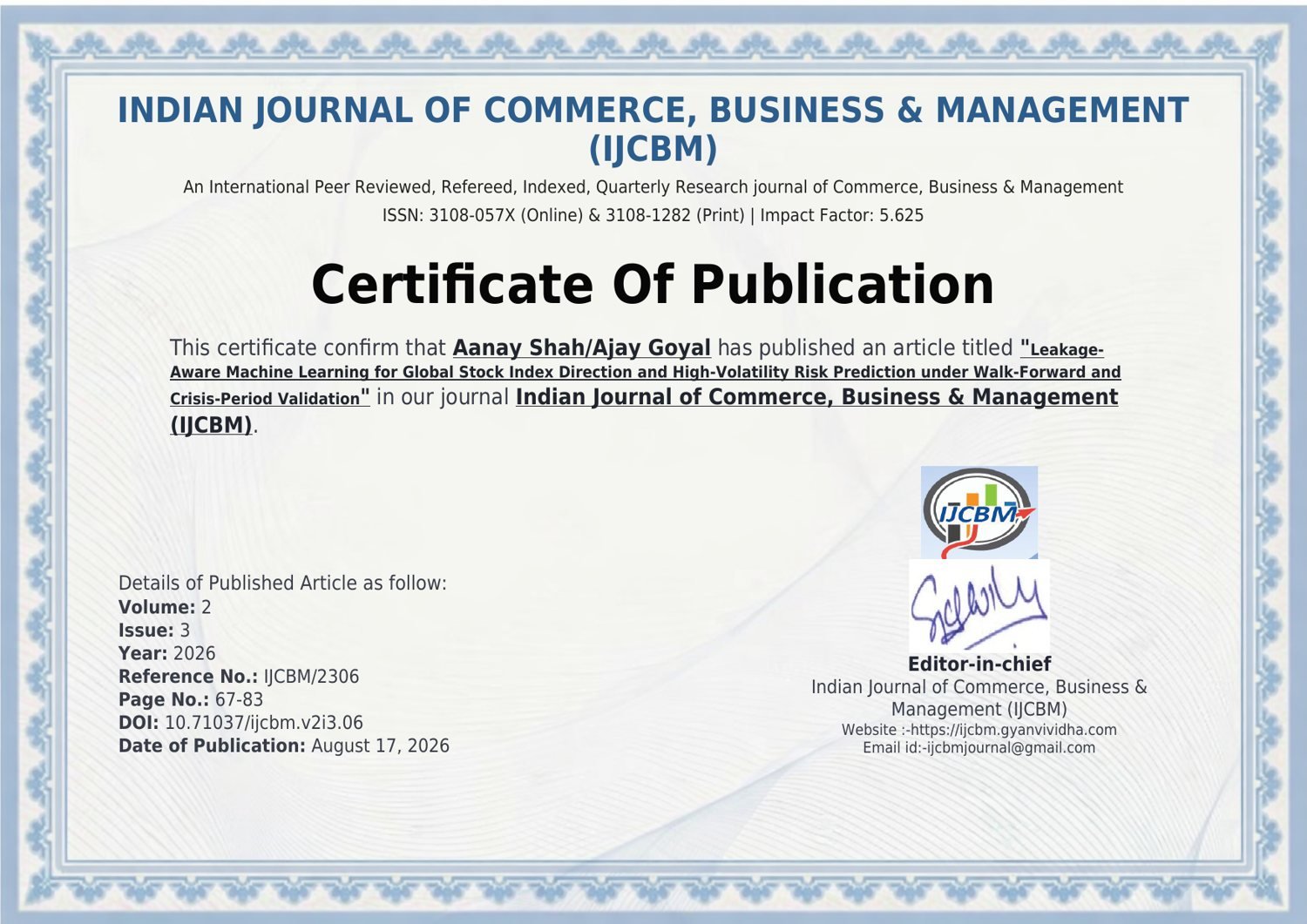
Leakage-aware machine learning for global stock index direction and high-volatility risk prediction
Aanay Shah & Ajay Goyal (Nirma University) · Indian Journal of Commerce, Business & Management · pp. 67–83 · DOI 10.71037/ijcbm.v2i3.06
The paper builds a framework that predicts next-day direction and high-volatility events across 14 indices using daily data from 2000 to 2026. Future information is kept out of the models, and results are checked with walk-forward testing and crisis periods.
Best results (Random Forest Bagged Trees)
- Predicting direction and predicting big moves are separate tasks.
- Never let a model peek at the future; test with walk-forward and crisis periods.
- Judge beyond accuracy: precision, recall, F1 and ROC-AUC.
- Good scores are not profits. Stay sceptical.
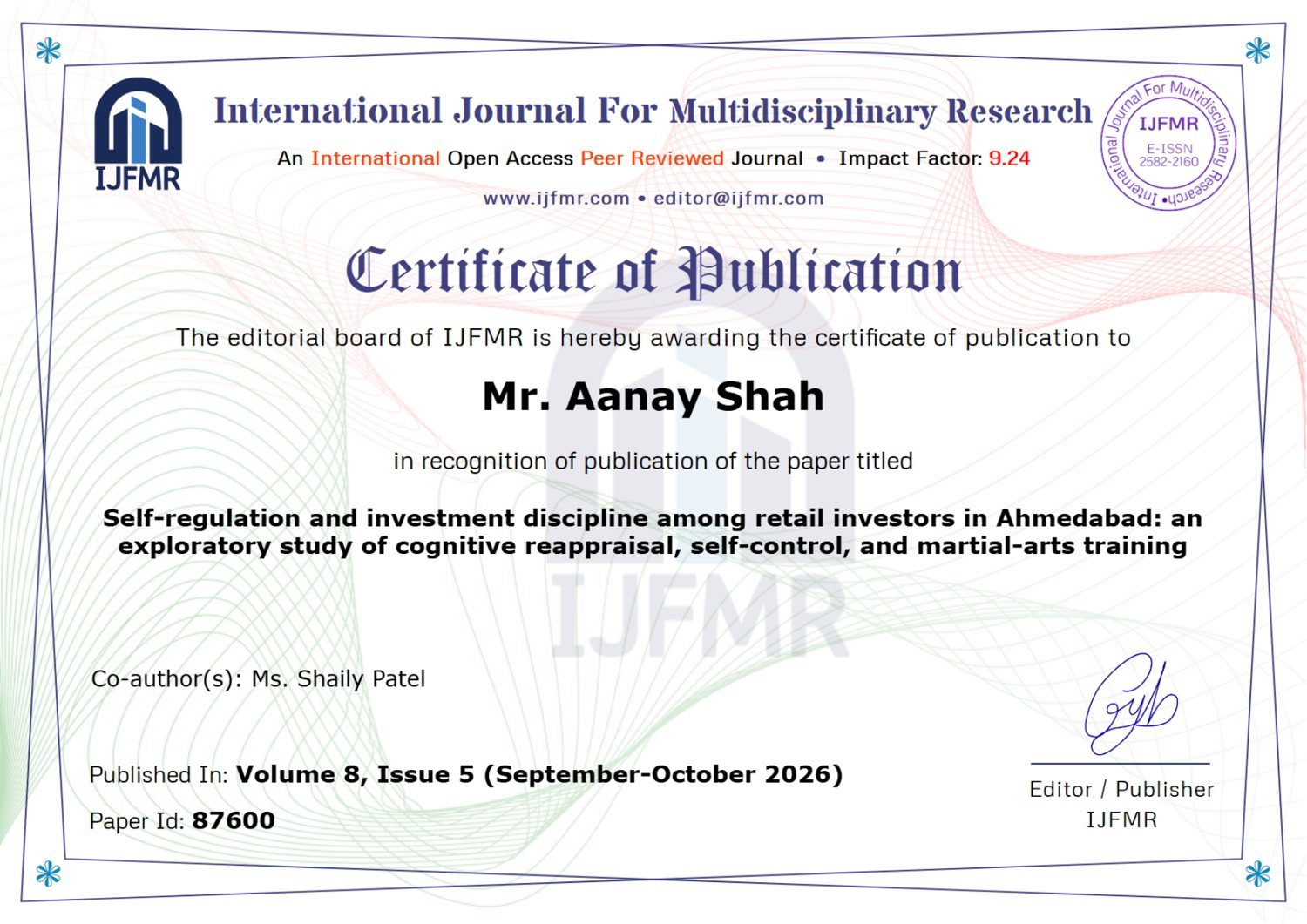
Self-regulation and investment discipline among retail investors in Ahmedabad
Aanay Shah & Shaily Patel (Gujarat University) · International Journal for Multidisciplinary Research · Paper ID 87600
An exploratory study of cognitive reappraisal, self-control and martial-arts training. A questionnaire of validated scales was given to retail investors; after screening, 60 valid responses were analysed, 11 of them from martial artists.
Takeaway: investors who stayed calm and rethought stressful situations managed money more carefully than those who simply knew more about finance. The martial-arts link shows hints, but the sample is small, so the paper provides effect sizes and a protocol for a larger study.
From research to practice.
The same curiosity drives my internships, where I analyse real companies and explain bonds to beginners.